
Last Updated: 08 March 2008 9:29 PM
Goal-line technology dumped in favour of
'six-referee' plan
By Andrew Smith of Scotland on Sunday at Gleneagles
Pictures from ISRS Cork:
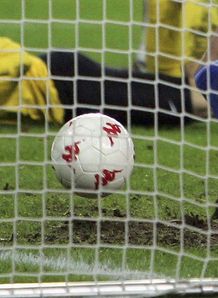
GOAL-line technology to determine whether a goal has been scored will not be
used in football for the foreseeable future, the game's law-makers ruled
yesterday. Instead, experiments will be carried out with an additional assistant
referee behind each goal.
The dramatic turnaround on technology came at the annual general meeting of the
International Football Association Board at Gleneagles Hotel.
The gathering also saw a failure to endorse Scottish Football Association chief
executive Gordon Smith's proposals to punish players retrospectively for
simulation missed by referees. It will still come into force in Scotland next
year, however, because it was agreed it should be a matter for individual
associations.
But it was the issue of goal-line technology which dominated the day.
The insistence by Football Association chief executive Brian Barwick that the
idea was "dead in the water" was the strongest sentiment expressed after a
meeting at which it was expected his FA's proposals for further trials with
two-camera systems would meet full approval. The technology appeared to have
received favourable feedback after being tested at the World Club Championships
in Tokyo.
But FIFA president Sepp Blatter and his UEFA counterpart Michel Platini applied
pressure on the board, made up of the heads of the four British Associations, to
reject a commitment to technology that had been expressed as main item on the
agenda at recent IFAB meetings. Instead of cameras, the potential of stationing
a referee behind each goal to rule on the ball crossing the line will now be
explored.
"Over the last two or three years goalline technology was creating the headlines
when we walked out of the room from these meetings and it will be again today,"
Barwick said. "I see it as dead in the water, and on the basis of what has
happened it is unlikely come back on to the agenda next year or for the
foreseeable future.
"That is very disappointing but we have to respect the integrity and democracy
of the board, with a majority decision against proceeding with further
experiments. We are driven by assisting the referee as best we can. Two
companies put a lot of time and effort into realising the technical ambitions
and I felt one system was well on its way to success with the other having
travelled two-thirds of the journey."
But it appears that Blatter, who had stated previously that the use of
technology was inevitable in football, has had his mind changed by Platini. FIFA
general secretary Jerome Valcke maintained that the FIFA president was never
unequivocal about benefits of cameras in the first place. "Blatter was clear in
saying that it was too early for any technological system to become part of FIFA
regulations," he said. "He was in favour of freezing all experiments of this
nature and experimenting with the traditional referees. That was the request of
Michel Platini. It was felt the technology would start with the goalline, then
the offside and then you would have cameras checking if it was a penalty and in
the end there would be a pitch with only cameras around. There was a big
question if you use the tradition of referees, why use technology? In one of the
experiments at the World Club Championships, one of the systems did not fully
show, where the other worked well."
David Williams, of the Welsh FA, was one of those who voted against continuing
to explore goal-line technology. He did so for fear of losing the character of
competition. "Football is a game played by human beings," he said. "Everyone
casts their minds back to 1966 and the Russian linesman and that is probably the
most famous example of a goal-line debate. These make the game and something
would be lost if supporters didn't have them. The sports who use technology are
far more stop-start than football."
No decisions have been made as to where, when and how the goal-line referees
will be tested. Barwick pointed out that a 50% increase in such personnel could
prove problematic, with recruitment and retention of referees already difficult.
It was also pointed out that six officials could make refereeing more rather
than less complex. Smith admitted he favoured further experiments with
technology but accepted the outcome on the issue and the 'cheats' charter'.
"Mr Blatter was very complimentary about the fact we have promoted procedures to
tackle simulation," the SFA chief executive said. "And while everyone agrees we
should be dealing with this, it was felt any measures taken should be left to
each association. We will proceed with our plan for next season and are going
through a pilot scheme at the moment. We have looked at UEFA's article 10, which
was the basis for UEFA acting against a player post the Scotland and Lithuania
game and giving out a two-match ban for simulation. It could be we incorporate
the wording of article 10 in our rules."
Smith and Barwick attended yesterday's Scottish Cup tie at Perth and both said
they are keen to see their two countries share a pitch at the earliest suitable
date. New Scotland manager George Burley rejected the chance to take his team to
Wembley on May 28 because he would have to select an understrength side. But
Smith insists the two countries' first confrontation in eights years has only
been postponed.
THE LAWMAKERS
The International Football Association Board (IFAB) is the body which decides on
the laws of the game.
� Established in 1886, the board was originally made up of representatives from
Scotland, Ireland, England and Wales. In 1913 representatives from FIFA, formed
in 1904, were also invited to join.
� Recent years have seen the introduction of rules which have changed the speed
of games and the board takes a strong view on over-physical play. IFAB also
looks at how to modify existing rules, particularly the offside rule and keeper
substitutions.
� There is a representative from each of the British associations and four FIFA
representatives. A three-quarter majority needs to agree a law change. A law
cannot, therefore, be passed by FIFA representatives alone.
� There are two meetings each year. The annual business meeting discusses
internal affairs while the annual general meeting, which takes place in either
February or March, discusses law changes.
The full article contains 1065 words and appears in Scotland On Sunday
newspaper.
Last Updated: 08 March 2008 9:29 PM