
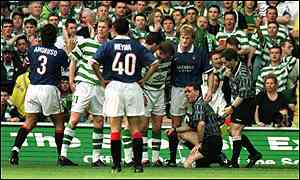
 Bloodied
but unbowed: Hugh Dallas suffers a fate no referee should have to endure after
being hit by a coin in an Old Firm derby in 1999 at Parkhead.
Bloodied
but unbowed: Hugh Dallas suffers a fate no referee should have to endure after
being hit by a coin in an Old Firm derby in 1999 at Parkhead.
A firm grip on the two tribes:
HUGH DALLAS
Published Date: 09 March 2003
I WAS in the back of the net with a swarm of
players, trying to dig out the troublemakers and calm things down, while trying
to remember their numbers and who was doing what to whom, so that I could deal
with them afterwards.
By the end of the match, I think that I had handed out nine yellow cards,
disallowed a goal and watched as a fan had raced across the pitch and jumped in
behind the technical areas.
I had been promised 90 minutes that I would never forget, and the game did not
disappoint. It was hairy, it was frantic, and it was more passionate than anyone
could possibly have imagined - it was my first Old Firm match.
That was November 19, 1995. The match was at Ibrox, and it ended 3-3. I still
remember all the major talking points clearly...
I remember John Hughes and Andy Goram squaring up in the goalmouth, and suddenly
a load of players were in the middle of it, and I was having to haul them apart;
I remember Pierre van Hooijdonk had already been booked, so when he wheeled away
after scoring the equaliser and ran right up to his own fans to celebrate, I
technically could have booked him and sent him off. But, by then, I had already
realised that Old Firm matches could not be treated like just another game.
Passions were running high, and that had to be taken into consideration.
Referees talk about Law 18 being the most important rule, and people will retort
by saying: "But there�s only 17 laws." Of course there are, but officials know
that Law 18 is unwritten, and it�s the law of common sense, and I�m still
satisfied that I applied it that day.
I also still picture the fan running on to the pitch, and thinking: "What next?"
It was obviously the first time it had happened in an Old Firm game I had
refereed, but it would not be the last.
That�s what Old Firm matches are like: blink and you will miss something. The
thing is, with millions watching on television and a stadium brimful with two
tribes, each as fanatical about their team as the other, referees can�t afford
to miss anything. It�s part and parcel of the job, but boy does it bring its own
pressures.
I suppose I was a bit naive in that first game; I think everyone is, whether you
are a player, manager, supporter or official. Nothing can prepare you for the
noise, the pace, the passion - and the microscopic scrutiny. Every decision,
every action is magnified and analysed, discussed and picked over. Everything is
seen in black and white.
In that first game, I just did not realise the magnitude of it all, which is
probably why I was less nervous going into that Old Firm match than any other
subsequently. Obviously, I knew it was a big one, and I was excited and honoured
to have been given it, but though I phoned round a number of more experienced
referees who had been there and done that, I was still amazed.
And I grew up in Scotland, knowing what�s at stake, and thinking that I knew
what it would feel like to walk out into the centre of the pitch just before
kick-off, struggling to hear myself think!
I think that�s why few foreigners can manage a good display in their first
Glasgow derby. They just are not properly prepared - they can�t be - and that�s
why I think the suggestion that we should bring in top referees from abroad to
officiate is sheer nonsense.
I�m very good friends with Pierluigi Collina, and I know for a fact that the
Italian would love to be in the middle in an Old Firm match. I think any referee
would, because it is such a big occasion and such a challenge, and if I was
pushed and had to chose between the kick I got out of refereeing the very best
players in the Champions League, or refereeing an Old Firm match, it would be a
close decision - but I would always chose our own battle of the giants.
But even the very best, such as Pierluigi and Anders Frisk, who were in charge
at the Champions League semi-final between Real Madrid and Barcelona last
season, admit that it�s hard when you go into a different country and walk in
cold to such a big game, one where more than the result is at stake.
I have refereed 15 of these games, and the only thing that is different about
taking charge today, compared to that first one, is that I�m probably more
nervous in the run-up. Not scared, because referees, particularly those
operating at this level, have strong personalities, but I�m more aware of
everything that could go wrong, and am anxious to eradicate the problems before
they become crises.
I know from experience that games could trundle along quite nicely for 60, 70
even 80 minutes, and then whoosh - something happens to light the blue
touch-paper, all hell breaks loose, and it�s up to you to make sure you are
totally alert and get on top of things before the situation gets out of control.
That�s why doing your homework, and getting to know the players and their
temperaments, is so vitally important.
While the personnel change, the games themselves do not. The fans are still as
passionate, the players - whoever they are, and even with the influx of so many
foreigners - are totally up for it, and even guys who are normally quite sane
and level-headed can lose it. The managers� emotions are heightened, and the
hype that surrounds the match, before and after, is never likely to let up, even
if this game is still being played in 1,000 years� time.
That�s why the referee is so important. Games would not even get under way
without a referee, and in my opinion, based on my experiences in these fixtures,
they certainly would not get finished without an official to man-manage
hot-headed players and generally do his damnedest to keep the game flowing, the
players safe and as many of them on the pitch as possible.
That�s the thing that the fans don�t see: they don�t see the fact that I hardly
shut up during these matches, constantly running alongside players, warning them
to keep it calm, or asking captains or cooler team-mates to intervene. They
don�t see me shouting: "Hey No5, arms down, arms down, arms down," or: "No 4,
don�t lunge in; stay on your feet," umpteen times throughout the match. They
just see me cautioning him eventually when he won�t take a telling, and seems
intent on an early exit.
Unfortunately, there have been a few of those over the years; guys like Paolo di
Canio, who is a genius with the ball at his feet, but so emotional, and who
possesses a temperament that would see him flare up in an instant.
As soon as I saw his name on the team-sheet, I knew that I would have my work
cut out getting him through the game. He wasn�t singled out in a bad way, but I
knew that maybe I would have to have a wee chat with him a tackle or two earlier
than I would if it was Paul McStay, or Henrik Larsson now. I needed to keep him
on a shorter lead for his own good.
The same was true of Gazza, who is another very clever footballer. The pair of
them could be a joy to watch and, when they were in the mood, they were the kind
of players you could exchange a bit of banter with, but when they lost it, they
really lost it.
I remember one game where Paul Gascoigne almost came to blows with Ally McCoist.
They were in the same team, for goodness sake, but emotions were running so
high, and I couldn�t repeat half what they said to each other. Again I could
have stepped in and cautioned both, but common sense prevailed, and a few
minutes later they were friends again.
But hot-headed players like Gazza and Di Canio are the ones you need to get on
top of, because you don�t want to have to send entertainers off. The fine line
that players are not allowed to cross is certainly a bit broader when you are
dealing with the intensity of Old Firm clashes, but once they cross it, they
still must walk.
That�s where team-mates come in. People like McCoist and McStay were examples of
peacemakers. No-one could doubt how much winning those games meant to them, but
they still managed to retain their sense of right and wrong, no matter how
heated things got. Those type of players are a blessing for referees.
As are guys like Paul Lambert and Arthur Numan in the current sides. They might
not always agree with my decisions, but they know that arguing won�t change my
mind, and all it could do is wind up other players or fans, and create a
situation that no-one wants.
Richard Gough was another who took his captain�s responsibilities seriously. At
the coin toss, he would always say: "Now, Mr Dallas, just you let me know if any
of the Rangers players step out of line, and I�ll deal with them." And I would
always reply: "Yes, but who do I speak to when you step out of line?"
But I do turn to the captains quite often if a player won�t take friendly
advice, and warn them that they should calm down the team-mate, or the next time
I have to talk to them, they will be seeing a yellow or red card.
Barry Ferguson has matured well in that respect, and is a lot more aware of how
he can influence the mood of the game as a responsible captain, as well as how
he can influence play as a midfielder. So it helps to have guys like him and
Lambert on the pitch.
With all the talk of hatred, most would be surprised at the amount of
good-natured banter between the sets of players and the referee, and that can
provide a vital tool in man-managing a game.
I remember a Celtic defender was displeased with McCoist, and was charging up
the field telling the Rangers player exactly what he wanted to do to him. I knew
it was out of keeping with the player�s game, and chances were he would calm
down, so when Ally shouted: "Hey, ref, you hear that? What you gonnae do about
it?� I said: "Nothing. I�m okay - it�s you he�s after, not me!" It defused the
situation; both started laughing.
There are others, though, who just do not wish to interact or talk to you, no
matter what. Oliver Khan is like that on the international stage, and in terms
of the Old Firm, Brian Laudrup was always quite quiet and gentlemanly, and
Larsson is the same. He is so focused that he shuts you out as much as possible,
and you have to read players and situations, and respect that as much as
possible.
I know what it�s like. I have my own routine in the build-up to matches and,
particularly on the day of an Old Firm match, my family just leave me alone. I
feel the need to just shut myself away and get psyched up. I suppose I retreat
into my own head, and even at the ground I go through a routine.
Just as you can walk into dressing-rooms before a match, and one has music
blaring and players shouting and geeing each other up, and the one next door can
be quiet with players getting themselves prepared in their own way - it�s the
same in the referee�s room. Some referees never shut up; some are really quiet.
I always like to have the radio on, listening to all the football chat as I�m
getting ready. At Ibrox, there is a telly in the ref�s room, and I�ll maybe
watch that for a while.
But I always make sure they are switched off before we go out, because the last
thing I want is to hear what the pundits are saying at half-time. That could be
really distracting or damaging when you still have another 45 minutes left to
concentrate on.
Because referees do make mistakes, and I�m not too proud to admit it.
The main thing I hope going into these games, though, is that the decisions I
have to make don�t have a real bearing on the result. I would hate that, because
no-one else can really know how low referees can feel when they realise
afterwards that they have blundered.
At the time, they were sure of a decision or they wouldn�t have given it, so
it�s always an honest error, but it still hurts when you realise it was wrong. I
know as I�ve done it in other big games on the world stage, but referees always
have been, and always will be, easy targets.
All I ask, before everyone rushes to condemn us the next time we make a mistake,
is that players and managers look at themselves in the mirror, and recall all
the tactical errors or bad passes they made in the same game. And that fans ask
themselves who made more mistakes in the 90 minutes - their players or the
referee?
Or, perhaps, recall how many wee errors or bad decisions they themselves have
made in their own jobs.
Most of all, I ask that they all remember two key things: whether they
believe it or not, referees are only human... and it�s just a game of football.
The full article contains 2390 words and appears in Scotland On Sunday
newspaper.
Last Updated: 09 March 2003 12:00 AM
Source: Scotland On Sunday
Location: Scotland