|
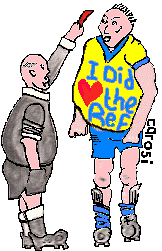
What is unsporting
behaviour�Law book .2006
A PLAYER IS CAUTIONED AND SHOWN THE YELLOW CARD IF HE/SHE IS
GUILTY OF UNSPORTING BEHAVIOUR.
Cautionable Offences.
1. Is guilty of unsporting behaviour. One of Seven.
A substitute or substituted player is cautioned and shown the yellow
card if
he/she commits any of the three offences.
1. Is guilty of unsporting behaviour. One of three.
Decision 3. Law 12 Fouls and Misconduct page 27.
Subject to the terms of law 12 a player may pass the ball to his own
goalkeeper using
his head or chest or knee, etc. if, however in the opinion of the
referee, a player uses a
deliberate trick while the ball is in play in order to circumvent the
law, the player is
guilty of unsporting behaviour. He is cautioned, shown the yellow card
and an indirect
free kick is awarded to the opposing team from the place where the
infringement
occurred.
A player using a deliberate trick to circumvent the law while he is
taking a free kick is
cautioned for unsporting behaviour and shown the yellow card. The free
is retaken.
In such circumstances, it is irrelevant whether the goalkeeper
subsequently touches
the ball with his hands or not. The player commits the offence in
attempting to
circumvent both the letter and the spirit of Law 12.
Decision 5 Law 12 page 27.
Any simulating action anywhere on the field, which is intended to
deceive the referee,
must be sanctioned as unsporting behaviour.
Decision 6 Law 12 page 27.
A player who removes his jersey when celebrating a goal must be
cautioned for
unsporting behaviour.
Law 15 The Throw in page 33.
If an opponent unfairly distracts or impedes the thrower; he is
cautioned for
unsporting behaviour and shown the yellow card.
Additional instructions for referees , assistant referees and fourth
officials
Cautions for unsporting behaviour by deliberately handling the ball page
73/ 74.
There are circumstances when, in addition to a free kick being awarded,
a player must
be cautioned for unsporting behaviour e.g. when a player.
� Deliberately and blatantly handles the ball to prevent an opponent
gaining
possession;
� Attempts to score a goal by deliberately handling the ball.
�A caution for unsporting behaviour is required when a player holds an
opponent to
prevent him gaining possession of the ball or taking up an advantageous
position.
Simulation page 75.
A player who attempts to deceive the referee by feigning injury or
pretending to have
been fouled is guilty of simulation and must be cautioned for unsporting
behaviour.
Dealing with inured players page 76.
As soon as the referee has authorised the doctors to enter the field,
the player must
leave the field, either on the stretcher or on foot. If the player does
not comply he is
cautioned for unsporting behaviour.
Gene Stephens Revision 2
QUESTIONS AND ANSWERS ON UNSPORTING BEHAVIOUR, LAW
BOOK 2006.
Law 1 / The field of play Q 3 Page 4.
A goalkeeper or another player draws unauthorised marks on the field of
play with his
foot. What action does the referee take?
If the referee notices this before the match starts, the offending
player is cautioned for
unsporting behaviour.
If the referee notices this being done during the match, he caution the
offending player
for unsporting behaviour when the ball next goes out of play.
Law 3 / The number of players Q4.PAGE 7.
If before the start of a match played under the rules of the
competition, a player is
replaced by a named substitute without the referee having been notified,
may this
substitute be permitted to continue to participate in the game.
Yes. The player will be cautioned for unsporting behaviour. The referee
will apply the
advantage or stop play. If the play is stopped to administer a caution,
it will be
restarted with an indirect free kick to the opposing team from where the
ball was
when play was stopped.
LAW 3/ The number of players Q8. PAGE 8.
A substitute enters the field of play without having obtained the
permission of the
referee, and his team plays with an extra player. While the ball is in
play, an opponent
violently punches him. What action should the referee take?
The referee stops play, sends off the player guilty of violent conduct,
cautions the
substitute for unsporting behaviour and instructs him to leave the field
of play. The
match is restarted with an indirect free kick to the opposing team where
the ball was
when play was stopped.
Law 3/ The number of players Q9. Page 9.
A player changes his poison with the goalkeeper without informing the
referee, when
he notices it, what action does the referee take.
The new goalkeeper then touches the ball with his hand in his own
penalty area. What
action does the referee take?
In both cases he allows play to continue and cautions both players for
unsporting
behaviour when the ball next goes out of play
Law 3/ The number of players Q13 / PAGE 10.
A substitute, warming up behind his own goal, enters the field of play
and prevents
the ball entering the goal with his foot. What action does the referee
take?
The referee stops play, cautions the substitute for unsporting behaviour
and the match
is restarted with an indirect free kick to the opposing team where the
ball was when
play was stopped.
Gene Stephens Revision 2
Law 3/ The number of players. Q14 / Page 10.
A substitute, who is not the goalkeeper, plays from the beginning of the
match
replacing a team-mate. The referee is not informed. This player plays
the ball
deliberately with his hand. What action will the referee take?
The referee stops play and cautions the substitute for unsporting
behaviour. The
player is instructed to leave the field of play for the substitution
procedure to be
completed correctly.
The match is restarted with an indirect free kick to the opposing team
from where the
ball was when the play was stopped.
Law 3 / The number of players. Q15 / page 10.
A substitute plays from the beginning of the match, replacing a team
mate. The
referee is not informed. An opponent commits a foul against the
substitute. What
action does the referee take?
The referee stops play and cautions the substitute for unsporting
behaviour. The
player is instructed to leave the field of play for the substitution
procedure to be
completed correctly and depending on the foul caution or send off the
player, or takes
no disciplinary action. The match is restarted with an indirect free
kick to the
opposing team from where the ball was when play was stopped.
Law 3 / The number of players Q16 / Page 11.
A player who been substituted, enters the field of play without the
permission of the
referee. What action does the referee take?
If the advantage clause is not applicable, the referee will stop play.
He will caution the
player for unsporting behaviour and will instruct the player to leave
the field of play.
Play will be restarted with an indirect free kick to the opposing team
from where the
ball was when play was stopped.
Law 3 / The number of players Q17 / Page 11.
A substitute who has joined the game without the permission of the
referee scores a
goal. The referee realises this before restarting play. What action does
the referee
take?
The goal is not awarded. The player will be cautioned for unsporting
behaviour and
instructed to leave the field of play for the substitution procedure to
be completed
correctly. The match will be restarted with a goal kick.
Law 3 / The number of players Q27 / Page 13.
A player playing with twelve players scores a goal and the referee
notices it before the
restart of play. What action does the referee take?
The goal is not awarded. Play is restarted with an indirect free kick to
the opposing
team in the goal area. The twelfth player is cautioned for unsporting
behaviour and
instructed to leave the field of play.
Law 3 / The number of players Q28 / Page 14.
A team playing against a team with twelve players scores a goal and the
referee
notices it before the restart of play. What action does the referee
take?
The goal will be awarded. The offending player is cautioned for
unsporting behaviour
and is instructed to leave the field of play.
Gene Stephens Revision 2
Law 4 / The players Equipment. Q3 Page15.
What action should the referee take if a player removes his shirt to
reveal a similar
shirt underneath?
The referee must caution the player for unsporting behaviour.
Law 4 / The players Equipment, Q7 / PAGE 16.
The referee requests a player to remove jewellery. After a number of
minutes, the
referee realises that the player is still wearing jewellery. What
actions should the
referee take?
The player must be cautioned for unsporting behaviour. The player is
instructed by
the referee to leave the field of play to remove the jewellery. If the
referee stops play,
He restarts with an indirect free kick to the opposing team from where
the ball was
when play was stopped.
Law 11. / Offside, / Q2 Page 23.
Does a referee penalise a player who is in an offside position and moves
off the field
of play to show the referee that he is not involved in active play.
No. It is not an offence in itself to be in an offside position and
there is no need for the
player to leave the field of play. However, if the referee considers
that he has left the
field for tactical reasons and has gained an unfair advantage by
re-entering the field of
play, the player should be cautioned for unsporting behaviour.
Law 11./ Offside./ Q4 Page 23.
An attacking players movement takes him between the goal posts into the
goal net and
at the same time, a team-mate kicks the ball into the goal. What action
does the
referee take if.
a) The player who is between the goal posts remains stationary as the
ball enters.
No action should be taken. A goal is awarded.
b) The actions of the player distract an opponent.
The goal is disallowed and the player is cautioned for unsporting
behaviour.
Since the offence was committed off the field of play, play is restarted
with a dropped
ball at the place where it was located when play was stopped.
Law 12 / Fouls and Misconduct. / Q 2 / Page 25.
While the ball is in play, two players of the same team commit
unsporting behaviour
or violent conduct towards each other on the field of play. What action
does the
referee take?
The referee cautions them or sends off and restarts play with an
indirect free kick to
the opposing team from where the offence occurred.
Law 12 / Fouls and Misconduct. / Q5 / Page 25.
An attacker goes past the goalkeeper and kicks the ball towards the open
goal. A
goalkeeper then throws a boot or similar object, which strikes the ball
and prevents it
entering the goal. What action does the referee take?
The goalkeeper is cautioned for unsporting behaviour and the match is
restarted by an
indirect free kick to be taken from the place where the ball was when it
was struck by
the boot or similar object.
Law 12 / Fouls and Misconduct / Q6 / Page26.
A player, other then the goalkeeper, standing in his own penalty area
holding a
shinguard, hits the ball with his shinguard to prevent it entering the
goal. What action
does the referee take?
The referee awards a penalty kick and the player is sent off for
preventing a goal. The
shinguard is regarded as an extension of the player�s hand.
What happens if, in a similar situation, the player in question is the
goalkeeper?
The referee stops play, cautions the goalkeeper for unsporting behaviour
and play is
restarted with an indirect free kick to the opposing team.
Law 12 / Fouls and Misconduct / Q9 / Page 26.
A player enters the field of play with out receiving a signal from the
referee and
deliberately handles the ball. What action does the referee take.
The player is cautioned for entering the field of play without the
permission of the
referee. Play is restarted with a direct free kick or penalty kick to
punish the more
serious offence.
If in the opinion of the referee, the player is also guilty of
unsporting behaviour, by
deliberately handling the ball, is sent off for receiving a second
caution in the same
match.
If, in the opinion of the referee the player is also guilty of denying a
goal scoring
opportunity, the player is sent off.
Law 12 / Fouls and Misconduct / Q10 / Page 27.
A player running with the ball sees a defender immediately in front of
him and runs
off the field of play to continue playing the ball. The opponent holds
him beyond the
touchline to prevent him continuing his run. What action does the
referee take?
Play is stopped and the opponent is cautioned for unsporting behaviour.
Play is
restarted with a dropped ball at the place where the ball was located
when play was
stopped.
Law 12 / Fouls and Misconduct / Q21 / Page 29.
The attacking team takes a throw-in and the ball goes to the defending
goalkeeper.
The goalkeeper misses the ball and a teammate punches the ball over the
bar. What
decision would the referee give?
A penalty kick would be awarded. The referee would normally caution the
player for
unsporting behaviour. The player does not prevent a goal or an obvious
goal scoring
Opportunity since a goal cannot be scored directly from a throw in.
Gene Stephens Revision 2
Law 12 / Fouls and Misconduct / Q22 / Page 29.
A player tries to prevent the ball entering the goal by deliberately
handling it. The
ball, however, enters the goal. What action does the referee take?
He awards the goal and cautions the player for unsporting behaviour.
Law 12 / Fouls and Misconduct / Q 23 / Page 29.
A player handles the ball deliberately, trying to prevent it reaching an
opponent.
Although he touches the ball, he fails to prevent his opponent receiving
it. What
action does the referee take?
Law 12 / Fouls and Misconduct / Q 27 / Page 30.
A player intentionally lies on the ball for an unreasonable length of
time. What action
does the referee take?
He stops play, cautions the player for unsporting behaviour and restarts
play with an
indirect free kick.
Law 12 / Fouls and Misconduct / Q35 / Page 32.
A player asks to leave the field of play and, as he is walking off, the
ball comes towards
him and he kicks the ball into the goal .What action does the referee
take.
The player is cautioned for unsporting behaviour. The game is restarted
by an indirect
free kick, taken by a player of the opposing team, from the place where
the
infringement occurred.
Law 14 / The Penalty Kick. / Q4 / Page 35.
When a penalty kick is being taken, and after the referee has given the
necessary
signal, a teammate of the player identified to take the kick suddenly
rushes forward
and takes it instead. What action does the referee take?
The referee stops play and restarts the match with an indirect free kick
to the
defending team where the infringement occurred i.e. where the player
advanced closer
then 9.15m. The player is cautioned for unsporting behaviour.
Law 15 / The Throw in. / Q3 Page 41.
A player, while correctly taking throw in, intentionally throws the ball
at an opponents
head. What action does the referee take?
Play is stopped if in the opinion of the referee, the player is guilty
of unsporting
behaviour or violent conduct. Depending on the action he is cautioned or
sent off.
Play is restarted with a direct free kick or a penalty to the opposing
team, from the
place where the offence occurred, i.e. the place the ball struck the
opponent.
TOP |
Cartoons
courtesy of
Julian C at
http://www.corshamref.net/
Remember the Pen is Mightier than the Sword!!!
Shhhh..
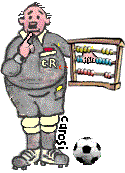
Yes 12 Players. Start Again!
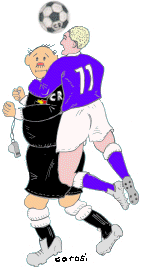
Now thats Unsporting!
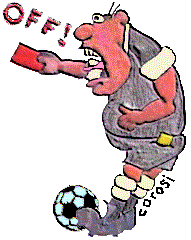
Be dignified! It will confuse em!
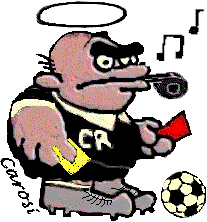
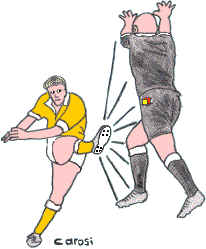
Ouchhhhhhhhhhhh!
|