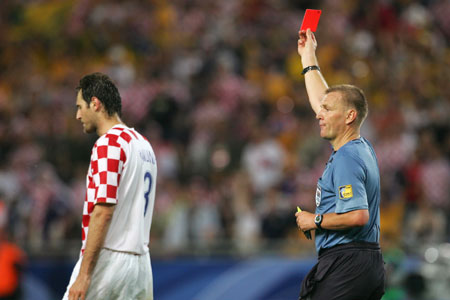
of the referee, who makes a decision at the time of the incident.
Coaches should inform their players of the points specified below
and to ensure that every game is played sportingly.
1. Serious Foul Play and Violent Conduct
Soccer is a tough, combative sport. The contest to gain
possession of the ball should nonetheless be fair and sporting.
Any actions meeting these criteria, even when vigorous, must be
allowed by the referee.
Serious Foul Play and Violent Conduct are, however, strictly
forbidden and the referee must react to them by stringently applying
the Laws of the Game.
These two offences can be defined as follows:
(a) It is serious foul play when a player uses excessive force,
formerly defined as "disproportionate and unnecessary strength,"
when challenging for the ball on the field against an opponent.
There can be no serious foul play against a team-mate, the referee,
an assistant referee, a spectator, etc.
(b) It is violent conduct when a player is guilty of aggression
(excessive force or deliberate violence) towards an opponent when
they are not competing for the ball. It is also violent conduct if
the excessive force is used when the ball is not in play, if it is
committed by a substitute or substituted player, or if it is
directed at anyone other than an opponent (e. g., team-mate,
referee, assistant referee, coach, spectator, etc.). If the violent
conduct is committed by a player against an opponent on the field
during play, the restart is a direct free kick for the opposing team
where the foul occurred (or a penalty kick if it was committed by a
player inside the player�s penalty area). If the violent conduct is
by a player during play against anyone on the field other than an
opponent, the restart is an indirect free kick where the misconduct
occurred. If the violent conduct is committed during a stoppage of
play, the restart is not changed. A dropped ball where the ball was
when play is stopped is the correct restart if the violent conduct
is committed during play and off the field. If the violent conduct
is committed by a substitute or substituted player on the field of
play, the correct restart is an indirect free kick.
2. Tackling
A tackle as such is not an infringement of the Laws of the Game.
It becomes an infringement only if the tackler plays carelessly,
recklessly, or with excessive force, or places the opponent in
danger.
(a) A sliding tackle from the front or side, made with one or
both legs, is permissible if, in the opinion of the referee, it is
not dangerous. If, however, the player making the tackle trips the
opponent before, during, or after making contact with the ball, the
referee shall award a direct free kick to the opposing team. The
referee must judge whether an illegal trip occurred or whether the
opponent fell over the leg of the player making a legal tackle.
(b) Tackling with the foot lifted from the ground may be
dangerous, whether contact is made with the ball or not. Lifting of
the foot should be penalised if the referee considers the player is
endangering an opponent by so doing. If the player deliberately
plays over the ball and makes contact with the opponent's leg, this
is serious foul play and must be sanctioned with a send-off (red
card) and a direct free kick (or a penalty kick, if appropriate).
(c) Tackling with two feet together, studs up, if uncontrolled
and from a distance, could be judged as at least reckless and
possibly dangerous to the opponent. If controlled and from a short
distance, there may be no danger.
(d) A tackle, regardless of direction, which endangers the safety
of an opponent must be sanctioned as serious foul play. The player
must be sent from the field (red card) and play restarted with a
direct free kick (or a penalty kick if committed by a player inside
the player's team's own penalty area).
3. Charging from behind
Charging from behind is permissible only if the opponent is
intentionally impeding while shielding the ball. The charge,
however, must be made fairly and under no circumstances to the back
(spinal area).
TOP
4. Reckless challenges
Referees should take stringent measures against players moving
their arms and elbows without due care, by applying the sanctions
available to them under Law 12.
5. Offences� against goalkeepers
It is an offence if a player:
(a) jumps at a goalkeeper under the pretext of heading the ball;
(b) moves or jumps about near a goalkeeper in order to distract
or interfere with or prevent the goalkeeper from releasing the ball;
(c) who is standing in front of a goalkeeper when a corner kick
is being taken, takes advantage of the position to impede the
goalkeeper before the kick is taken and before the ball is in play;
(d) makes any play for the ball while the goalkeeper is still
controlling it with the hands. Kicking or attempting to kick the
ball held by the goalkeeper is considered to be dangerous play.
6. Impeding the progress of an opponent
A player who has the ball under control within playing distance
(i.e., the distance at which the player is covering the ball for
tactical reasons in order to avoid its being played by an opponent, without using the arms) is not
guilty of impeding the progress of the opponent.
Any player who intentionally impedes the progress of an opponent
by crossing directly in front of or running between the opponent and
the ball or intervening so as to form an obstacle with the aim of
delaying the opponent�s advance, must be sanctioned with an indirect
free kick in favour of the opposing team.
However, any player who intentionally impedes the progress of an
opponent by physical contact, whether using the hand, arm, leg, or
any other part of the body, shall be penalized for holding by the
award of a direct free kick to the opposing team, or by a penalty
kick, if the offence was committed within the player�s team�s
penalty area.
7. Scissors or bicycle kick
Such a kick is permissible, provided that in the opinion of the
referee it is not dangerous to an opponent.
8. Jumping at an opponent
A player who jumps at an opponent under the pretext of heading
the ball shall be penalized by the award of a direct free kick to
the opposing team.
9. Prohibited use of body
A player who holds off an opponent using the hand, arm, leg, or
body (except through a legal charge) is guilty of an infringement of
Law 12 and shall be punished by the award of a direct free kick to
the opposing team. Holding or hindering when the ball is out of play
in order to prevent the opponent from running into position is
misconduct and shall be penalized by a caution for unsporting
behaviour.
10. Caution for handling the ball or holding an opponent
A caution for unsporting behaviour is appropriate if a player:
(a) holds an opponent to interfere with attacking play (e.g.,
prevents the opponent from getting to the ball or pulls an opponent
away from possession of the ball),
(b) handles the ball to interfere with attacking play, or
(c) handles the ball in an attempt to score a goal.
(Note: if handling the ball or holding the opponent prevents a
goal or interferes with a goal scoring opportunity, the offender
must be shown the red card and sent off the field.)
11. Free kicks
A player who delays the restart of play or fails to respect the
required distance when play is being restarted must be cautioned.
TOP
12. Use of advantage
If the referee applies the advantage and the advantage which was
anticipated does not develop after a short time, i.e., 2-3 seconds,
and the ball remains in play, the referee should immediately stop
the game and penalize the original offence.
13. Denying a goal or an obvious goal scoring opportunity
(a) If, in the opinion of the referee, a player who is moving
towards the opponent's goal, with an obvious opportunity to score a
goal, is denied that goal scoring opportunity by an offence
punishable by a free kick or penalty kick, the offending player
shall be shown the red card and sent off the field of play.
(b) If, in the opinion of the referee, a player, other than the
goalkeeper within the goalkeeper�s own penalty area, deliberately
handles the ball to prevent it from entering the goal and thus
denies the opposing side a goal or an obvious goal scoring
opportunity, the player shall be shown the red card and sent off the
field of play. There need not be an opponent nearby with an
opportunity to play the ball.
14. Penalty kick
(a) Positioning of ball and players during a penalty kick
During a penalty kick, the goalkeeper shall stand on the goal
line. Apart from the goalkeeper and the player taking the kick, all
the players shall take up a position on the field of play behind the
penalty mark and outside the penalty area at least 10 yards (9.15 m)
from the penalty mark and stay there until the ball is in play
(kicked and moved forward).
(b) Penalty kick at the end of a half or at the end of the match
If play is prolonged before half-time or at the end of the match
to allow for a penalty kick to be taken or for one to be retaken, a
goal shall be allowed if, before going into the goal, the ball
touches any combination of the goalposts, crossbar, goalkeeper, or
ground (providing no other infringement has been committed).
(c) Unless the ball has entered the goal (in which case the kick
is retaken), infringements of Law 14 by the kicking team must be
punished with an indirect free kick from the place where the
infringement occurred.
15. Player in offside position
(a) It is not an offence in itself to be in an offside position.
(b) A player shall be penalized for being offside if, at the
moment the ball touches or is played by one of that player�s
team-mates, the player is, in the opinion of the referee, involved
in the active play by
1. interfering with play or with an opponent, or
2. gaining an advantage by being in that position.
(c) A player shall not be penalized for offside by the referee
1. merely because the player is in an offside position, or
2. if the player receives the ball directly from a goal kick, a
corner kick, or a throw-in.
An assistant referee must not signal merely because a player is
in an offside position. Furthermore, if an assistant referee is in
any doubt as to whether a player is offside (active position) or not, the referee should
decide in favour of the attacker; in other words, refrain from
signalling offside.
16. Goalkeeper restrictions
An indirect free kick is awarded to the opposing team if a
goalkeeper, inside the goalkeeper�s own penalty area,
� takes more than six seconds from the moment of establishing
control with the hands until the ball is released into play
� touches the ball again with the hands after it has been
released from the goalkeeper�s possession and has not touched any
other player outside the penalty area or has touched only a
team-mate inside the penalty area
� touches the ball with the hands after it has been deliberately
kicked to the goalkeeper by a team-mate
� touches the ball with the hands after receiving it directly
from a throw-in taken by a team-mate
17. Persistent infringements
Any player who repeatedly infringes the Laws of the Game by
committing multiple fouls or by participating in a pattern of fouls
directed at an opponent shall be cautioned and shown the yellow
card.
TOP
18. Substitution
When a substitution is to take place, the substitute shall report
to the fourth official (or assistant referee) and surrender the
substitution card (if applicable), properly completed, at the
halfway line. A player who is going to be replaced may not leave the
field of play without the referee's permission and then only when
the ball is out of play. The substitute may then enter the field at
the halfway line after receiving a signal to do so from the referee.
The substitute must be fully ready to play before reporting to
the appropriate official. Referees should not delay the timely
restart of play to allow substitutes to correct their equipment or
uniforms before entering the field nor shall the referee prevent a
team from restarting play if the substitute has not reported to the
appropriate official prior to play being stopped. There is no
requirement that the player leaving the field must do so at the
halfway line.
19. Injury of a player
If a player is bleeding, that player must leave the field
immediately to have the bleeding stopped and the skin and uniform
cleaned as thoroughly as possible. When the player is ready to
return to the game, the player�s injuries and the uniform must be
inspected by an official. This can be the referee or, if delegated
by the referee in the pregame conference, the fourth official or, if
there is no fourth official, an assistant referee. Only then will
the referee give permission for the player to re-enter the game; the
game need not be stopped in this situation.
Only the referee may permit the return to the field of play of a
player who was instructed to leave the field for treatment of an
injury. This is not a substitution. The player who left the field
for treatment of an injury may return during play with the permission of the referee, but only from the touch line. If
the ball is out of play, the player may return with the permission
of the referee across any boundary line.
Up to two team officials are permitted to enter the field of play
with the referee's permission solely for the purpose of assessing an
injury�-not to treat it�and to arrange for the player's removal.
The referee must exercise care before allowing removal of a
seriously injured player from the field.
In all cases where an injury was the sole reason for the stoppage
of play, the injured player is required to leave the field and
cannot be permitted to return until the referee gives permission
after play has restarted
20. Attitude towards referees
Any player who protests at an official's decision may be
cautioned. Any player who assaults or insults an official shall be
sent off. The captain of a team, although responsible for the team's
behaviour, has no special rights.
21. Throw-in
A throw-in may not be taken from a distance of more than one yard
(one meter) outside the touch line. Players who stand in front of
the thrower in such a way as to harass the thrower or to interfere
with the throw-in must be cautioned for unsporting behaviour and
shown the yellow card. Opponents must remain at least two
meters/yards from the point where the throw-in is taken. If they do
not, they must be cautioned and shown the yellow card for failing to
respect the required distance.
22. Delaying the restart of play
Any player who delays the restart by wasting time shall be
cautioned. The following actions are examples of this behaviour:
- takes a free kick from a wrong position with the sole intention
of forcing the referee to demand a retake;
- appears to prepare for a throw-in but suddenly leaves it to a
team-mate to perform the throw-in;
- performs any restart in such a way that the ball is not
properly put into play, thus forcing a repetition of the restart;
- kicks the ball away or carries it away with the hands after the
referee has stopped play for any reason;
- stands in front of the ball when a free kick has been awarded
to the opposing team in order to give the team time to organize the
defensive wall;
- excessively delays taking any restart;
- delays leaving the field when being substituted;
- provoking a confrontation by deliberately touching the ball
after the referee has stopped play
TOP
23. Celebration of goal
(a) After a goal has been scored, the player who has scored it is
allowed to share the joy with team-mates. However, the referee must
not allow them to spend an excessive amount of time in their
opponents' half of the field. Neither shall the referee allow
players to taunt their opponents. In any of these cases, the referee
will caution the offending player for unsporting behaviour. Referees
must look beyond the behaviour of players celebrating goals and
consider as misconduct only those actions which are provocative,
obscene or insulting, or which unnecessarily delay the restart of
play.
(b) If a player removes the shirt to celebrate a goal, the player
must be cautioned for unsporting behaviour and shown the yellow
card.
A player must be cautioned when he or she:
� in the opinion of the referee, makes gestures which are
provocative, derisory or inflammatory
� climbs on to a perimeter fence to celebrate a goal being scored
� removes the shirt over the head or covers his/her head with the
shirt
Leaving the field to celebrate a goal is not a caution able
offence in itself but it is essential that players return to the
field as soon as possible.
Referees are expected to act in a preventive mode and to exercise
common sense in dealing with the celebration of a goal.
24. Liquid refreshments during the match
Players shall be entitled to take liquid refreshments during a
stoppage in the match but only on the touchline. Players may not
leave the field during play to take liquids. It is forbidden to
throw plastic water bags or any other water containers onto or from
the field.
25. Players' equipment
(a) The referee shall ensure that each player wears the uniform
properly and check that anything worn by the player conforms with
the requirements of Law 4. Players shall be made aware that their
jersey remains tucked inside their shorts and that their socks
remain pulled up. The referee shall also make sure that each player
is wearing shinguards and that none of them is wearing potentially
dangerous objects (such as watches or other jewellery of any
nature).
(b) Players are permitted to wear visible undergarments such as
thermopants. They must, however, be the same colour as the shorts of
the team of the player wearing them and not extend beyond the top of
the knee. If a team wears multicoloured shorts, the undergarment
must be the same colour as the predominant colour.
(c) The referee, assisted as needed by the assistant referees,
shall ensure that player equipment and uniforms comply with Law 4
and will pay particular attention to any items (e.g., braces) worn
by a player which are not included in the standard uniform.
d) All items of jewellery are considered potentially dangerous.
Jewellery may not be worn. Taping jewellery is not adequate
protection. Rings, earrings, leather or rubber bands are not
necessary to play and the only thing they can bring about is injury.
26. The Role of the Fourth Official
The Fourth Official will assist the referee at all times. The
fourth official must indicate to the referee if the wrong player is
cautioned or when a player who has been given a second caution is
not sent off or when violent conduct occurs out of the view of the
referee and assistant referees. The referee, however, retains the
authority to decide on all points connected with play.
27. Trickery (cf. Law 12 IFAB Decision 3)
A player using a deliberate trick to circumvent the text and
spirit of Law 12 regarding deliberate passes to the goalkeeper shall
be cautioned for unsporting behaviour and shown a yellow card.
28. Technical area
Team officials may convey tactical instructions to players during
the game. However, team officials must remain within the confines of
the technical area while doing so and must conduct themselves, at
all times, in a responsible manner. Only one person at a time may be
standing in the technical area, giving instructions to the team.
The technical area may be defined as an area covering the length
of the substitutes' bench plus one yard on either side and extending
from the front of the bench up to a distance of one yard (one meter)
away from the touchline. It is recommended that markings be used to
define this area, but the absence of such markings does not relieve
team officials from the obligation to behave responsibly. The
referee may sketch out a technical area if one is not marked and if,
in the opinion of the referee, this is needed to assist in the
control of sideline behaviour.
29. Simulation (Law 12, IFAB Decision 5)
Any simulating action anywhere on the field, which is intended to
deceive the referee, must be sanctioned as unsporting behaviour.
A number of specific actions may be considered cautionable as
unsporting behaviour. These include faking an injury or exaggerating
the seriousness of an injury and faking a foul (diving) or
exaggerating the severity of a foul.
TOP
30. Misconduct by substitutes or substituted players
(a) Referees must caution and show the yellow card for unsporting
behaviour, dissent, or delay of restarts by substitutes or
substituted players.
(b) Substitutes or substituted players who are sent off and shown
the red card must leave the vicinity of the field of play and the
technical area. If their offence involved the use of violence or excessive force, the referee must
report the reason as violent conduct.
31. Dealing with injured players
Referees must follow the instructions below when dealing with
injured players:
� play is allowed to continue until the ball is out of play if a
player is, in the referee�s opinion, only slightly injured
� play is stopped if, in his opinion, a player is seriously
injured
� after questioning the injured player, the referee authorizes
one, or at most two doctors, to enter the field to ascertain the
type of injury and to arrange the player�s safe and swift removal
from the field
� the stretcher-bearers should enter the field with a stretcher
at the same time as the doctors to allow the player to be removed as
soon as possible
� the referee ensures an injured player is safely removed from
the field of play
� a player is not allowed to be treated on the field
� any player bleeding from a wound must leave the field of play.
The player may not return until the referee is satisfied that the
bleeding has stopped. A player cannot wear clothing with blood on it
� as soon as the referee has authorized the doctors to enter the
field, the player must leave the field, either on the stretcher or
on foot. A player who does not comply is cautioned for unsporting
behaviour
� an injured player may only return to the field of play after
the match has restarted
� an injured player may only re-enter the field from the touch
line when the ball is in play. When the ball is out of play, the
injured player may re-enter from any of the boundary lines
� the referee alone is authorized to allow an injured player to
re-enter the field whether the ball is in play or not
� if play has not otherwise been stopped for another reason, or
if an injury suffered by a player is not the result of a breach of
the Laws of the Game, the referee restarts play with a dropped ball
� the referee allows for the full amount of time lost through
injury to be played at the end of each period
TOP